
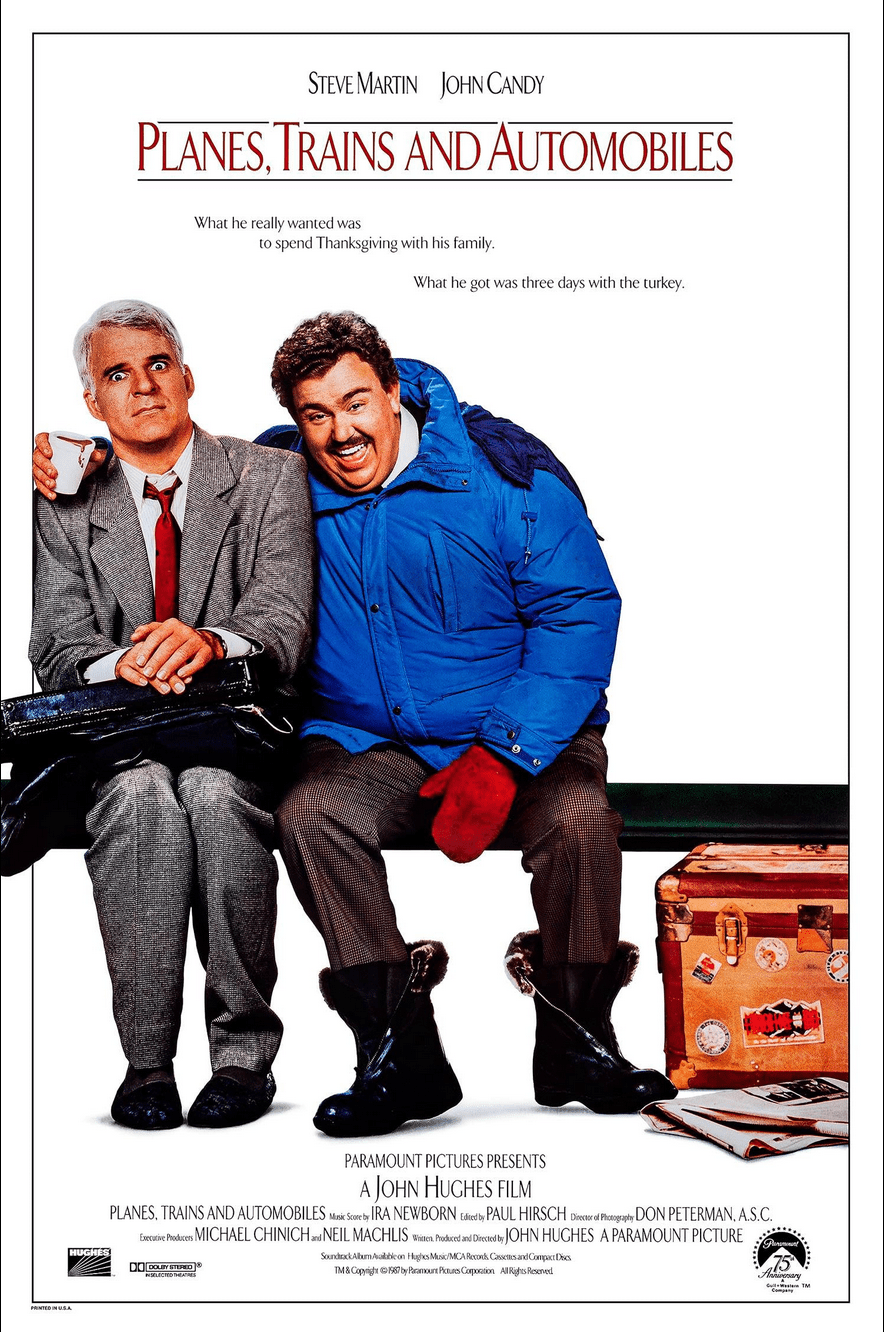
The image above is the original poster for the movie, found on IMDB. If you haven’t already seen this movie from 1987 (Rated R – smoking, foul language, sexual content), you should seek it out, or catch it when it’s on TV this holiday season. Spoilers below!
Jeff and I went to see one of my favorite movies at the Alamo Drafthouse last week before Thanksgiving. Although I’ve watched it many times broadcast on TV and have even rented it on streaming platforms, I wanted to see it on a big screen and appreciate the slapstick with an audience. This is a comedy for sure, but the more I watch it, the more I appreciate the tremendous amount of heart in this film.
Here’s a synopsis: Steve Martin and John Candy are an amazing comedic duo in this movie about high-powered advertising executive, Neal Page (Martin), trying to get from New York to his home in Chicago for Thanksgiving. Through a series of unfortunate events, he ends up stuck with shower curtain ring salesman Del Griffith (Candy) – an over-the-top, gregarious, awkward, and messy man. As they make their way across the country using various modes of transportation, they get into all sorts of hijinks with Neal almost coming completely undone. Yet, in the end, they learn how to appreciate each other with all their foibles. Finally alone on the “L” train headed home, Neal flashes back to their (mis)adventures and realizes Del was reaching out, in desperate need of connection and love. Postponing his arrival at home yet again, Neal returns to find Del alone in the train station. There, he learns Del’s beloved wife Marie has been dead for 8 years, he is alone, and has been traveling with no place to call home since her death. Moved, Neal invites him to his family’s Thanksgiving – the goal he has been seeking the entire movie.
Blessings and joy, it seems, are even better when shared with others. Even more, Neal realizes how much he had been neglecting his own family in his pursuit of success at work. It took a horrible trip with a stranger to point it out, but it changes his life. Del, too, realizes that he’s been running and unmoored since his wife’s death. In the end, they realize how much they need each other – one to find real authentic human connection once again and one to be shaken out of his crippling striving for success. It’s a look at the gift of friendship, companionship, and community.
In the theater, I mouthed along with the lines and quotes I knew so well. I giggled and laughed out loud with the rest of the audience – sometimes even in anticipation of the gag I knew was coming. I felt sadness and empathy when there was tension and anger between the two characters. And in the end, I cried as they both made their way home to themselves, to each other, and to family and friendship.
But this time, I noticed that the screenwriter, producer and director John Hughes had woven a lovely visual metaphor right into the fabric of the film: Del Griffith’s huge steamer trunk.
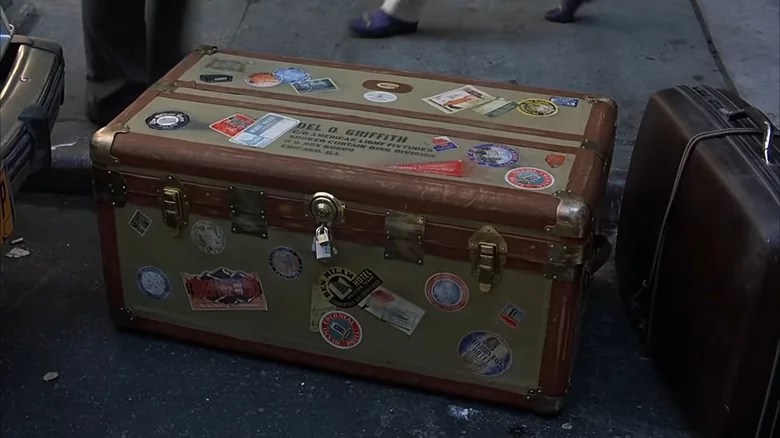
If you’re packing too much for a trip, people might joke that you’re lugging around – or should be lugging around – a steamer trunk. These trunks were used for long journeys at home or abroad from the late 18th to the early 20th centuries. My great-grandfather used one when he brought all of his belongings with him as he emigrated from Europe to the Unites States. The trunks were reinforced and built to last on rough carriage rides, train trips, and/or ocean voyages. All of this makes Del’s use of such a trunk anachronistic even in the 1980s.
John Candy’s portrayal of traveling salesman Del Griffith is larger than life. He’s a cringey character, maybe even for the most open-hearted and compassionate among us. The fact that he’s hauling around a ginormous trunk only serves to increase the cringe factor and the feeling that this man is, well, a burden. But there’s a greater underlying message in this hard-to-maneuver, ubiquitous piece of luggage (it’s even featured on each of the various posters I found in my sleuthing).
At each pivotal moment, the steamer trunk is there. In the opening scenes, racing a business man (Kevin Bacon!) for a cab, Neal Page is sent sprawling into the busy street when he falls headlong over the trunk. Just a few beats later when he thinks he’s secured another cab, the cab pulls away with – you guessed it! – the steamer peeking out of the partially opened taxi trunk.
As their paths cross again and again, the trunk is in view and serves almost a supporting role. They sit on it waiting for a truck to pick them up after a terrible night together at the motel in Wichita, Kansas. After saying farewell and boarding a train which very quickly breaks down, we see Del beginning to drag it a mile over a furrowed field to the highway to be picked up by bus. Frustrated at the train breakdown and at the prospect of having to interact with Del again, Neal sees him struggling to carry the burden of the overturned, upside-down trunk by himself. With a roll of his eyes and a sigh, he walks across the field to pick up the other end of the trunk.
After a terrible and angry encounter with the rental car agency who leaves Neal stranded without a car, Neal tries to get a taxi to Chicago. Next comes an altercation with the man at the taxi stand, in which Neal is punched and ends up flat on his back in the road. The next shot is of a car with the trunk strapped on the roof screeching to a stop just before running him over.
On the road to Chicago, the next time we see the trunk is when it flies off the roof rack of the car when they slam on the brakes going between two semi-trucks. Neal’s small suitcase and briefcase also end up in the middle of the road. As passing cars swerve around the huge trunk, they run over Neal’s briefcase. Moving their luggage out of the road, they sit on the trunk together as their car bursts into flames. Discovering that his wallet with his credit card was still in the glove compartment when the car caught fire prompts Neal to punch Del. In a rage, Neal once again falls over the trunk.
They make up at the motel when Neal invites Del in out of the cold. From there, we see them bundled up and shivering, sitting on the trunk in the refrigerated container of a cheese truck. When they part ways in Chicago, Del is left alone with the trunk on the “L” train platform. Neal finds him and the trunk alone in the station. The shot that shows us how the conversation unfolded in the station is a shot of Neal and Del walking down the middle of the road to Neal’s house with the trunk in between them to the song “Every Time You Go Away.”
This steamer trunk too heavy for Del by himself but it’s all he has. It’s his life. It’s what’s helpful and necessary. It’s his burden. It’s his past. It’s his grief. In interacting with the trunk, Neal trips over it, is frustrated and annoyed with it’s very existence, and he also helps Del carry it. Every time Neal recommits to Del, he commits to lifting and carrying this burden with his friend.
In contrast, Neal’s briefcase is boring, generic, and narrow, and gets run over frequently. It’s a reflection of and a commentary on what Neal’s world has become: a flat, efficient, picture-perfect existence, too focused on work and success, toiling away under a driven and inconsiderate boss. Not the trunk. It’s unique, covered in collected stamps/stickers, sturdy, and stable. It’s been through a lot and it has a lasting presence. In some ways, it almost functions to serve as a reminder of the fullness embracing abundance and all the messiness life includes – love and loss, imperfection and joy, and the challenge of relationship.
It’s easy to find ourselves identifying with Neal – we want to establish ourselves, provide for our families, succeed in whatever we do, and try to be decent in the process. But Neal’s frustration when things don’t go as expected and his struggle to adapt to finding hope, joy, and gratitude in the moment – no matter what the circumstance – also feel familiar. His simmering dissatisfaction with and anger at the world don’t need much poking and prodding to come to the surface. Del’s ability to chat to anyone and make friends easily, to offer help, to roll with the punches, and pick himself up to try again serve him well, but he also puts a smiling facade on the loneliness he carries. It’s hard for him to really ask for the deeper help he needs and his jolly nature makes it hard for people to perceive how much he’s hurting.
We have so much to learn from both of these characters, their strengths and their struggles, and the way they are there for each other. No one can carry a steamer trunk by themselves. A slim briefcase only makes room for or holds so much.
As we continue through Advent and into Christmas, may this film be an invitation to think about relationship, community, and how we accompany each other through life. In the coming weeks, we will most likely find ourselves at holiday parties and spending time with co-workers, colleagues, acquaintances, friends, and family. Who knows? We may even find ourselves traveling on planes, trains, and automobiles…
Wherever you are, safe travels, friends!
For some more insights into this fabulously well-done film and the role of the trunk, check out:
- http://thebigpicturemagazine.com/screengem-del-griffiths-travel-trunk-in-planes-trains-and-automobiles-john-hughes-1987/
- https://www.looper.com/899912/things-you-only-notice-the-second-time-you-watch-planes-trains-and-automobiles/
© Annabelle P. Markey
 Journeying Together
Leave a comment