
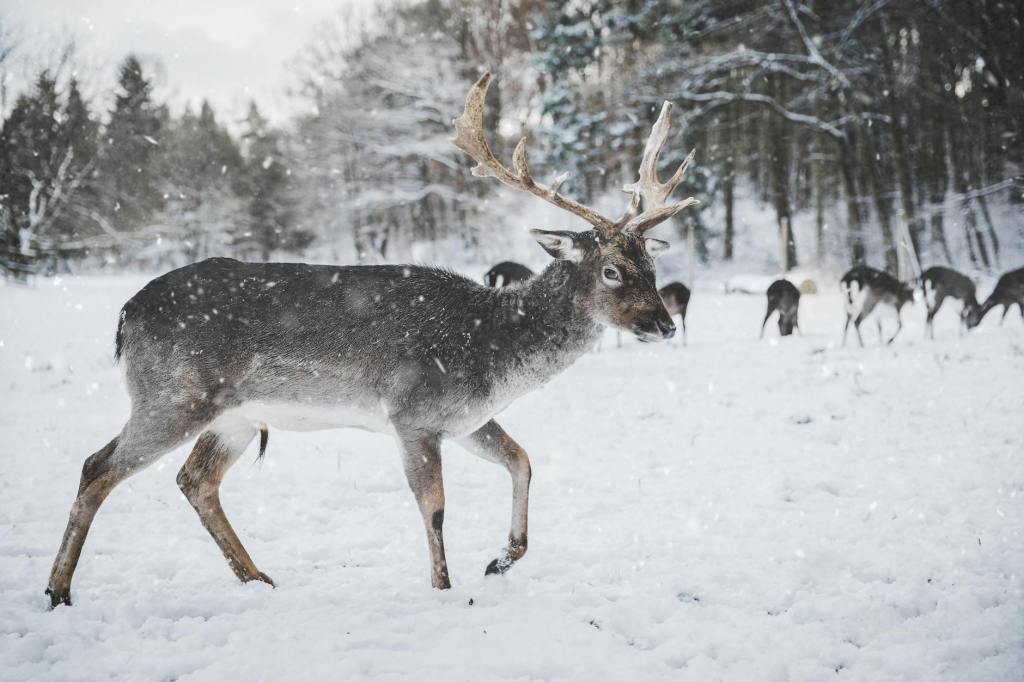
Last December, I stumbled across a fact that made me stop and read it again. That made me ask questions and filled me with awe. That lodged in my brain waiting for the right moment. The statement that got me was this: reindeer (yes, those reindeer!) eyes change color in the winter.
Now, I knew that animals often shed or changed their coat in different seasons (ask me about Labrador Retriever fur!), that birds often molt (I wrote about this a couple weeks ago), and that snakes shed their skin, but changing eyeball colors seemed like a whole other level!
So I started reading and found this fascinating article from National Geographic. It turns out that reindeer are able to change the reflective, mirror-like layer of their eyes – the tapetum lucidum – from a summer to a winter setting. Like switching out colored contact lenses to match our moods, reindeer have evolved and adapted to change this layer to better suit their needs.
In the summer, the tapetum lucidum (Latin for “bright tapestry” or “bright carpet”) is an opalescent gold streaked with turquoise, but in winter, this layer becomes a deep, brilliant blue. This shift happens because during Arctic winters the sun doesn’t even come up over the horizon for more than 60 days. For 12-24 hours a day, there is shadowy blue twilight in which to maneuver and survive. Scientists found that because their tapeta shift, gathering the collagen fibers more closely together to allow more light to be picked up through the photoreceptors, reindeer can even see into the Ultraviolet (UV) range.
What’s amazing is that the very lichen the reindeer need to survive harsh winter conditions absorb UV, making them pop against the snow. Similarly, reindeer are better able to spot their predators in a bleak landscape because the fur of wolves and polar bears also absorb UV light. Nicholas Tyler, a researcher at the Centre for Sami Studies at the Arctic University of Norway in Tromsø, is quoted in the article: “…the sensitivity of their eyes is at least a thousand times higher in winter than in summer.”
Essentially, the eye change makes them better able to spot what they need and what they need to run from even when the landscape makes it near impossible for others to see.
Maybe it wasn’t Rudolph’s nose that was needed to guide the sleigh, but eyes capable of discerning in harsh conditions.
Although other animals like dogs, cats, raccoons, and seals who need to see in low light use a variation of this as well, this adaptation is fairly unique in how dramatic it is. It’s also very effective.
Humans don’t have this ability, but it made me wonder, what if we did?
Tapetum Lucidum
What if…
as twilight descended,
the delicate tapestry of cells
wove more tightly together,
deepening not only
our eyes’ natural hue
but their ability to
perceive and embrace
graciously given light
even in the darkest of places?
What if…
in the depressing dimness
and isolating chill
that covers all
we were better able
to grasp what was necessary,
nourishing us to carry on –
able to flee from
all that stalks and divides,
seeking to devour us in the night?
With this in mind, what might we perceive with richer clarity?
How might such sight change our ability to thrive?
What is the light we would look for?
Advent, a season of expectation and waiting – of longing for the light of God to break into our lives – begins on December 1. Even as the shadows and darkness of winter days lengthen, may you look for and perceive the light of love, hope, peace, and joy. The light of Christ that has come and is still shining into the world without fail.
© Annabelle P. Markey
 Journeying Together
Leave a comment