Our home has a hill out that slopes downward from the front yard into the drainage ditch. Water flows off of everyone’s yards into these ditches and flows under each driveway through corrugated metal pipe. It’s a good system, I suppose, except for the mowing hazard it presents. Using a push mower on this hill is tantamount to taking your life in your hands. It’s steep and, depending on how much rain we’ve had, can be slippery. I’ve affectionately named it the “hill of death!” As a result, I’ve opted for using the safer weed whacker, which is tedious and an excellent arm and back workout.
Still, I love gardening and yard work, mainly because I get to be outside in the fresh air, but also because working with my hands moves me from living in my head to be present and using my whole body. For me, it’s embodied prayer. However, if you were to talk to my husband, to do yard work is a fate worse than death!
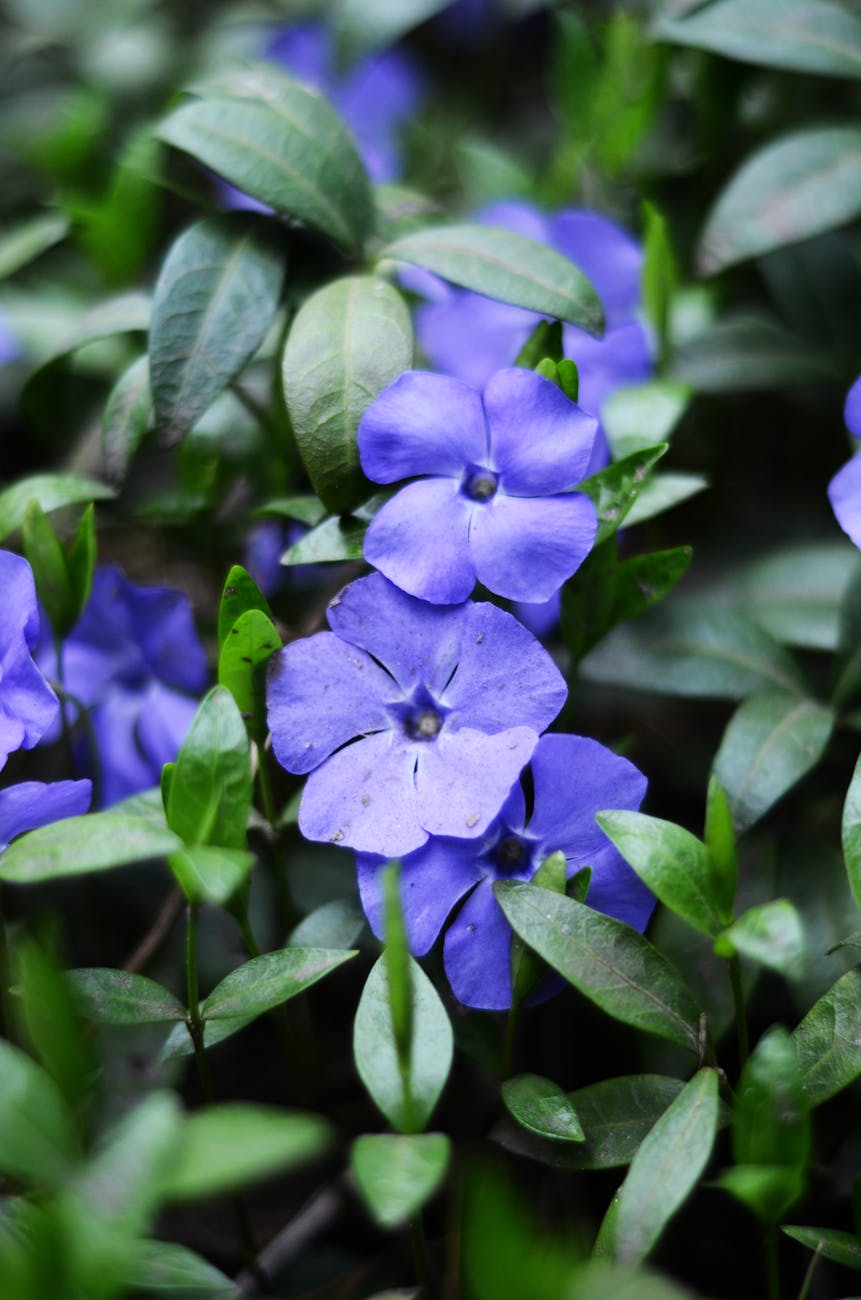
Which is why it was no small miracle that in May 2020, I somehow convinced the love of my life to help me plant 100 Periwinkle (vinca minor) seedlings on this front hill. Maybe it was the boredom of COVID lock-down combined with a need to do something productive, but he agreed and off we went, digging holes in the clay and planting the little viney plants. I had seen them at the local nursery, as well as around the neighborhood, and I was excited that they would spread on the hill, providing ground cover, and, if we were lucky, eliminating the need to mow or weed whack over time.
Those little vines grew and spread, and they did indeed begin to take over the hill. Over the years, I’d tried to plant various ground cover plants on the hill, but none seemed to do well – except for the Periwinkle. Those green shiny leaves in cross-shaped groupings of four and the purple flowers brought joy at the thought of not having to take care of that hill.
But then I became curious about identifying the flora and fauna around me. Apps like Seek and iNaturalist, and even Google Lens (note: this is not always as accurate!) made snapping a picture and trying to sort out an ID far easier than before. I started reading up on and learning more about native and invasive species, and I began my Virginia Master Naturalist course.
Through all of this, I came to understand that I had planted 100 seedlings of an invasive species in my front yard. An invasive species simply means that it is not native to the area – this means it has not evolved over time within the ecosystem. These plants are often aggressive, or spread quickly, while at the same time offering little or no ecological benefit to native flora or fauna who have had little time to adapt to their presence – e.g., pollinators can’t feed on them, the habitat for amphibians is impacted, they crowd out sensitive wildflowers, etc..
And I bought and planted them in my yard.
So after a lot of procrastination, last weekend, I began digging and pulling them out. It took hours and a lot of audio book listening, but I got them out. And as I was pulling, it occurred to me that these vines are an incredible visual representation of the invasive things in our lives, whether unhealthy habits or patterns, or sin (Martin Luther defined sin as the soul curved in upon itself; sin is all those ways we turn inward rather than to God and our neighbor).
A lot of these things start small, and maybe, we even invite them in initially, thinking it’ll be a welcome or beneficial thing in the landscape of our lives. Slowly, but persistently, they can spread. Even then, maybe there’s a beautiful flower or a pop of color, convincing us this was a good idea. But what is the effect over time? What is being choked out or impeded by allowing these habits, patterns, or sin to spread?
Maybe it’s an inability to be present to what is as we practice avoidance or numbing ourselves through scrolling on social media or zoning out with television.
Maybe it’s missing out on rest and God’s provision as we say “yes” to too many things and feel burned out, burdened, or simmering resentment.
Maybe we struggle to find empathy or to see the humanity in the other, instead finding interest in gossip or speculation.
Maybe we forget that we are enough or that we have enough as we race to keep up with everything marketing convinces us is “necessary.”
As my wrists and back ached from pulling up the stubborn Periwinkle, I sighed knowing this would be an ongoing, and quite literally, uphill battle. But I found hope, too.
I saw that the native plants I had put in even before the Periwinkle had also been slowly spreading. I found other native plants thriving and hosting pollinators, not because I had planted them, but because they had found a suitable space to grow.
Our lives are a garden in which we can grow all manner of things, both positive and negative. And it takes a lot of work to keep the invasives at bay, but what is worth the tending? What might grow, albeit slowly, if we give it a chance and care for it with consistency?
© Annabelle P. Markey
 Journeying Together
Leave a comment